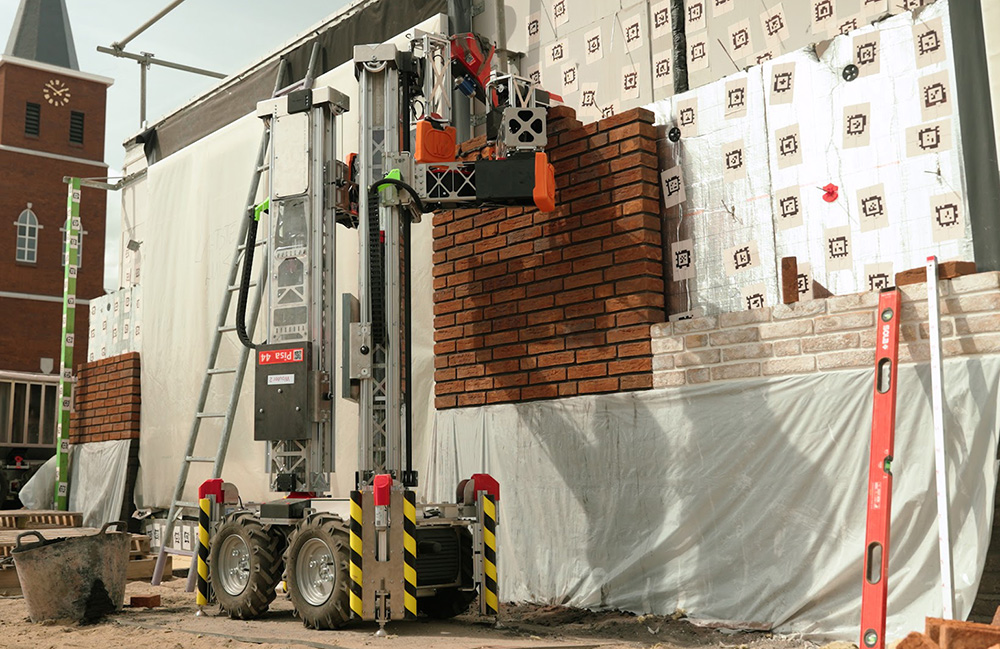
Monumental’s Pisa robot, which is in charge of laying bricks and mortar. | Source: Monumental
Currently, 92% of contractors have a difficult time filling roles in construction, according to the Association of General Contractors. At the same time, the U.S. is short 4.5 million homes. Developers like Monumental are betting on robots to help bridge this gap.
Construction’s labor issues will only continue to get worse, assuming the current trends continue. More and more people are retiring from the industry, while fewer young people are interested in getting into it. Salar al Khafaji, the founder and CEO of Monumental, believes construction’s labor shortage presents a unique opportunity for robotics.
“Construction is a really interesting use case for robots and AI, because it’s one of the few industries where the narrative is really not AI and robots coming in to replace labor to make things cheaper or redundant,” al Khafaji told The Robot Report. “It’s literally there’s not enough people to do the work. We desperately need this technology.”
Monumental is developing a fleet of robots that can handle construction tasks. The company decided to start with bricklaying for two main reasons. The first is because bricklaying is difficult work, said al Khafaji. He said he believes if the team can automate this task, it can likely take on a range of other tasks on a construction site.
The second reason goes back to labor. “If you look at Western Europe, bricklayers are literally the No. 1 job-shortage category in multiple countries, like the U.K., the Netherlands, and Germany,” al Khafaji said.
The three stages of construction, and where robotics is seeing traction
You can break down the construction process of a typical home into three major stages, al Khafaji said. The first is in ground preparation, where you use excavators and ground movers to build the foundation of a building. This is the stage where we have seen the most momentum for robotics so far.
“We’re seeing a lot of autonomous construction robotics companies that are doing excavators, ground movers, Caterpillar-like machines,” al Khafaji said. “These are heavy machines, they’re not precise.”
In this stage, there are companies like Bedrock Robotics, Gravis Robotics, TerraFirma, HIVE, Built Robotics, and more. These companies have seen some large funding round recently, including $200 million for Gravis Robotics, $115 million for TerraFirma, and $270 million for Bedrock Robotics.
Monumental doesn’t see these companies as its competitors, as it works in the second phase of construction, building the shell. “We want to do brickwork, but also block work and other things just to build our shell,” al Khafaji said. “That’s where I actually see not a lot of competition today.”
Then there is the finishing phase, where you have to put up drywall, lay flooring, and do all the things that turn a shell of a building into a home. This category, al Khafaji said, has had even less interest from robotics. There was Canvas Robotics, which created drywall finishing robots. The company’s core technology was acquired by Oshkosh at the start of this year.
Much of construction work boils down to material handling
Monumental has built three robots to handle the bricklaying process on construction sites.
“The main robot that you can see in our videos is called Pisa. That the pick and place and the bricklaying robot. It has two tiny tower cranes, basically with two arms. It’s non-humanoid,” al Khafaji said. Pisa has one arm that picks and places the bricks while the other extrudes mortar to place in between the bricks.
The other two robots on the site are in charge of making sure Pisa has enough bricks and mortar to keep working. One, Petra, brings bricks, while the other, Panama, supplies mortar.
“A lot of things in construction actually are about material handling,” al Khafaji said. “If you go observe construction workers, you see them with wheelbarrows moving around material all the time. Solving material handling is really important on a construction site.”
Monumental’s three robots are built on the same platform, which opens the door to adding more robots to the fleet in the future. al Khafaji estimated that only 10% of the technology the company is building is strictly related to brick-laying. The other 90% is technology that is more generally related to operating a robot in a construction site.
Additionally, the team uses Pathion, a mushroom-shaped device, to help the robots communicate. The company puts one or more at a worksite and it provides 4G, 5G, Starlink computes, and Wi-Fi.
How do you navigate a fragmented industry?
On any one construction site, there could be upwards of a dozen subcontractors working together to make a final product. This makes the industry very fragmented, which can be an advantage and a disadvantage. Monumental navigates this by acting as another subcontractor on the site, it just shows up with a team of robots instead of people.
“In other industries, you actually might struggle, because you have to deeply integrate into some enterprise customers,” al Khafaji said. For example, if you want to sell to a large automotive company, you’re going to have to integrate into its existing infrastructure.
“No one is vertically integrated. It is fragmented,” al Khafaji said. “So, they’re used to, if I need this thing to be done, I need foundations to be poured, or plumbing to be done, I’m just going to call up this company, and they’re going to send a couple of dudes, and they’re just going to do the thing. That’s how they operate. No one expects that subcontractor to follow their playbook.”
But there are challenges that come with working on a site with a range of subcontractors. Challenges that any subcontractor, robotic or not, would have to grapple with.
“The challenges basically have to do with all the dependencies,” al Khafaji said. “You can do everything right, but if you show up and the bricks were not delivered, you’re not going to lay bricks. It doesn’t really matter how good your robots are.”
There are some companies, like Reframe Systems, that are taking a completely different approach. Instead of acting as a contractor, Reframe seeks to build entire homes using its robotic microfactories.
Learning from deployments will be key to scaling
So far, Monumental has learned its biggest lessons from being out in the field deploying its robots. The company prioritized getting deployments in its first year of operation.
“We’ve always said we don’t want to be a robotics lab where we build stuff that doesn’t touch the reality for a year or something like that,” al Khafaji said.
On site, the team has come across scenarios it could spend years trying to predict and plan for. For example, al Khafaji said, before its early deployments, the team had spent a lot of time training its computer vision models to recognize bricks, which are similarly shaped but not completely uniform.
“We use computer vision models to measure them, to identify them, to look at the corners,” al Khafaji said. “There’s all this stuff happening, and we only heard a couple weeks before that deployment that the bricks that were going to be used were pitch black bricks, absolutely pitch black. I’d never seen them before.”
The model, which had been trained on the typical red bricks and some other lighter colors, was not able to recognize the black ones. The team had to retrain it to be able to handle the job. “We got new data. This is actually why it’s great to do these deployments. You get real-world data,” al Khafaji said.
Right now, the robotic construction industry is generally in the small pilots stage, which is really a learning stage, al Khafaji said.
“You need more examples of brick colors, weather, construction size, different regions, different countries, different regulations. Then you build a data set rich enough where you can 10x now, we can 100x now, and it’s not going to break apart. We understand the edge cases,” al Khafaji said.
al Khafaji asserted that it’s more of a matter of time and getting the work done and said he believes robots will only continue growing in construction.
 Register now and help us celebrate 20 years of RoboBusiness!
The post What bricklaying has taught Monumental about robots in construction appeared first on The Robot Report.


